We are going to be talking about something that seems small but is super important. Today’s topic is What Is a Milligram (mg)? I’m going to be breaking down the milligram for you because it’s one of those units we see all the time, but do we really get it? So, let’s just dive right in.
Milligram: Unit of Mass (What it Measures)
Okay, so the very first thing to get straight in your head is that a milligram is a unit of mass, right? So, what it measures is how much “stuff” is in something. It’s not how big it is, that’s volume. It’s not how long it is, that’s length. It’s how heavy it is; it’s its mass, it’s the amount of matter that’s in that object. And it’s a tiny amount of matter, but it’s still a measure of mass. Okay, so that’s the foundation: it’s about mass, it’s about how much stuff there is.
Milligram in the Metric System (mg, g, kg)
So, where does this little guy fit in the metric system?
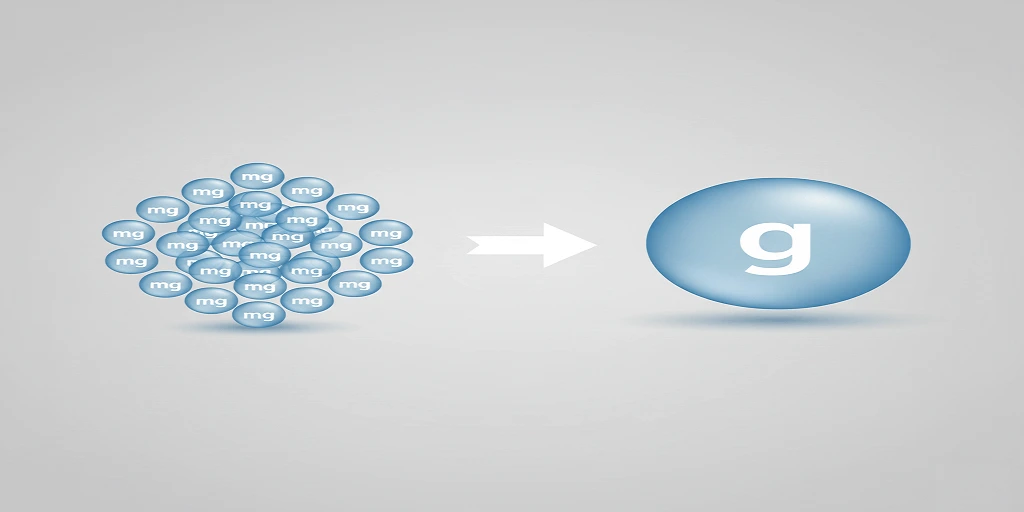
We’ve got the metric system, which is all beautiful and based on tens. You’ve got your kilogram, which is the big one; you’ve got your gram, which is the everyday one; and then you’ve got the milligram, which is the tiny one. So, in the metric system, you’ve got mg, g, and kg. And the key thing here is that that prefix “milli” means one thousandth. So, a milligram is one thousandth of a gram, and a gram is one thousandth of a kilogram. So, it’s just this nice, clean system of a thousand. A thousand milligrams make up one gram, and a thousand grams make up one kilogram. It’s that simple.
Milligram vs Gram vs Kilogram, A Quick Comparison
But let’s make that real. What’s the quick comparison?
Well, think about it this way: a kilogram is about a bag of sugar. You can feel that, you can hold that. A gram is about a paperclip. You know, a standard small paperclip, that’s about a gram. But a milligram? That is tiny. It’s like a grain of salt, maybe even a little bit less than that. It takes a thousand milligrams to make up that one little paperclip. So, you can see just how small we are talking here. It’s a unit for precision, for when you need to measure very, very small amounts of stuff.
Common Uses of Milligrams
So, where do we see this thing? What are the common uses of milligrams in the real world?
Medicine & Medication Dosage
Well, the biggest one, the one you probably see every day, is medicine and medication dosage. Okay? You look at a bottle of pain reliever, and it’ll say 500 milligrams, or 500 mg, of acetaminophen. Or a prescription might say take 25 milligrams of this drug. It’s super precise because medicine is powerful, and the difference between 25 milligrams and 50 milligrams can be a huge deal in your body. So, they use this tiny unit to get the dose just right.
Chemistry & Lab Work
Another big place is chemistry and lab work. You’ve got scientists in their lab coats, and they’re not just pouring things. They are using these super-sensitive scales to measure out chemicals in milligrams because, in a chemical reaction, a tiny bit too much of one thing can completely change the result or even make it dangerous. So, they need that level of precision that the milligram gives them.
Everyday Examples (Supplements, Ingredients, etc.)
And then you’ve got your everyday examples. You might not think about it, but it’s there. On your Vitamin C supplement, it’ll say 500 mg of Vitamin C. On your protein powder, it might say 25 mg of a specific amino acid. And even on food ingredients, if you look at the nutrition label, you’ll see things like sodium or caffeine listed in milligrams because, even though they’re a small part of the food, they can have a big impact on your body.
Why Understanding mg Matters for Liquid Conversion
But here’s the really important part, and this is where everyone gets tripped up: Why understanding mg matters when you’re dealing with liquids.
Difference Between Mass and Volume
Okay, so the first thing you need to know is the difference between mass and volume, right? I said it before: mass is how much stuff is in something; volume is how much space it takes up. Think about it: a cup of feathers and a cup of lead shot. They both take up the same amount of space, they have the same volume, but that lead shot is way heavier, it has way more mass. So, mg is a measure of mass, but when we’re talking about liquids, we often talk about volume in milliliters, or mL. And they are not the same thing. They are completely different measurements of completely different things. If you want to get a better handle on the volume side of this, you should check out our article on What is a Milliliter (ml)? That’ll really help you out with that.
When You Need to Combine mg with mL or Density
So, when do you need to bring these two ideas together? Well, you need to combine mg with mL or with density when you’re trying to figure out how much of a liquid to take when the dose is given in mass, in mg. You can’t just assume that 10 mg is the same as 10 mL. It’s not, it’s just not because different liquids have different densities. Density is basically how much mass is packed into a certain volume. Water is kind of the standard, where one milliliter of water weighs about one gram, which is a thousand milligrams. But a thick syrup like cough medicine has a different density; it’s heavier for the same amount of space. So, 10 mL of that syrup is going to weigh a lot more than 10 mL of water. To convert between the two, you need to know the density of that specific liquid. It’s the bridge that connects the mass (the mg) to the volume (the mL).
This is where a dedicated tool can be a lifesaver. You can use an online milligram to milliliter calculator to handle the conversion for you.
This is why it’s so important, especially with medicine, because if you get this wrong, you could take way too much or way too little of a drug. So, if you’re ever in a situation where you need to do this, you have to be super careful, and you should definitely read our guide on How to Convert Mg to Ml. It walks you through the whole process step-by-step because it’s a skill that’s not just for science class; it’s for life. It can keep you safe.
Conclusion
So, there you go. We’ve broken it down. We’ve talked about what a milligram is, we’ve seen how it fits into the metric system. We’ve looked at where we use them: in medicine, in labs, and even on our vitamin bottles. And, most importantly, we’ve talked about why it’s so crucial to understand the difference between mg (a measure of mass) and mL (a measure of volume), and how density is the thing that connects them. I hope that clears things up for you. It’s one of those small details that makes a big difference in how we understand the world around us.